
Engagement Ring Buying Guide: 8 Things Most Buyers Overlook

Buying an engagement ring can quickly turn into a crash course in diamonds.
You start with carat weight. Then come cut, color, clarity, natural versus lab-grown diamonds, settings, metals, grading reports, and dozens of nearly identical rings open
in browser tabs.
But some of the details that matter most are not the ones receiving the biggest headlines.
A beautiful center stone is only one part of an engagement ring. The way the ring is constructed, how the diamond is secured, how it sits on the finger, and what information the seller provides can all affect how confident you feel about the purchase.
This engagement ring buying guide focuses on eight details buyers often overlook before saying yes.

1. The Side of the Ring Can Tell You More Than the Top
Most engagement ring photos are designed to show the ring from its most flattering angle.
Usually, that means looking directly at the center stone from above.
Do not stop there.
The side profile of an engagement ring can reveal how high the center stone sits above the finger, how the setting is constructed, and how exposed the stone may be during everyday wear.
A high-profile setting can create a dramatic look and showcase more of the center stone. It may also be more likely to catch on sweaters, gloves, hair, or other objects.
A lower-profile ring may feel more practical for someone who works with their hands frequently or prefers jewelry that sits closer to the finger.
Neither style is automatically better.
The important question is whether the ring makes sense for the person who will actually wear it.
When shopping online, look for clear side-view photos or videos rather than relying entirely on the hero image.
2. The Prongs Are Small, but Their Job Is Important
Prongs may not be the first feature you notice, but they are part of what keeps the center stone secure.
Engagement rings may use four prongs, six prongs, claw prongs, double prongs, V-shaped prongs, bezels, or other setting styles.
The design can influence both appearance and protection.
A four-prong setting may expose more of the diamond. Additional prongs can provide more contact points around a stone. Some diamond shapes with pointed tips or corners may also benefit from additional protection in those vulnerable areas.
You do not need to become an expert in jewelry construction before buying a ring.
You should, however, be able to see how the center stone is held and feel comfortable asking questions if the setting is difficult to understand from the listing.

3. A Very Thin Band Is Not Automatically Better
Delicate engagement rings are popular because a narrow band can make the center stone look larger and create a refined appearance.
But the shank, the part of the ring that wraps around the finger, also has to withstand everyday wear.
The thinner and more intricate a ring becomes, the more important construction can be.
That does not mean a delicate ring is a poor choice. It means appearance should not be the only consideration.
Also look at whether the band contains pavé diamonds or other small stones.
A diamond-set band can add beautiful sparkle, but it may also influence future resizing, maintenance, and repair.
Before choosing a ring based entirely on how thin or delicate it looks, consider how it will fit into the wearer's everyday life.
4. Carat Weight Does Not Tell You Exactly How Large a Diamond Will Look
One of the most common engagement ring misconceptions is that carat is simply a measurement of size.
Carat actually measures weight.
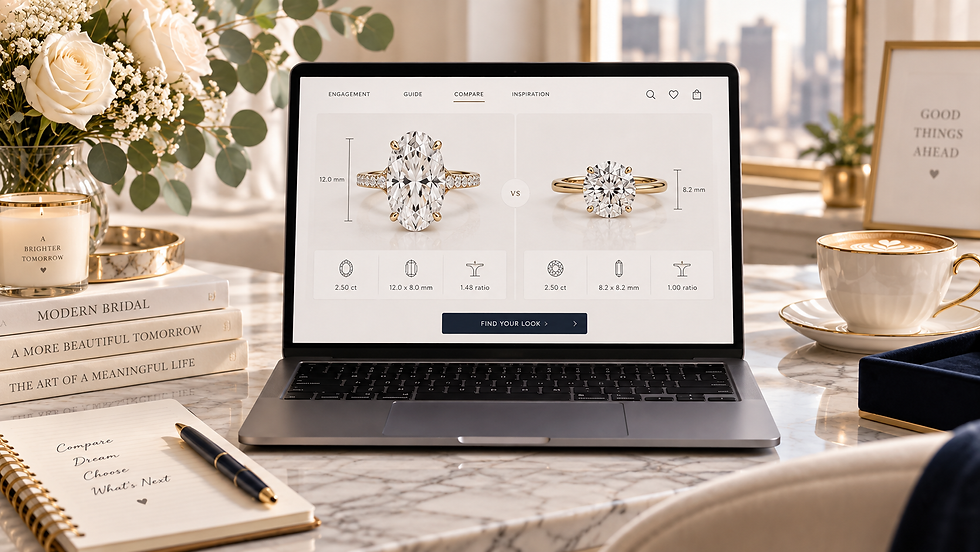
Two diamonds weighing the same amount can look different when viewed from the top because their proportions and dimensions are different.
This is especially noticeable with elongated shapes such as oval, pear, marquise, radiant, and emerald-cut diamonds.
When comparing diamonds, look beyond the carat number.
The millimeter measurements can help you understand how the stone may appear on the finger.
This is also why automatically choosing the heavier diamond does not always result in the look you prefer.
Sometimes the better question is not, "Which diamond weighs more?"
It is, "Which diamond gives me the appearance I actually want?"

5. Total Carat Weight and Center Stone Weight Are Not the Same Thing
Engagement ring listings can include several different references to carat weight.
A ring might have a one-carat center diamond.
Another might contain one carat total weight spread across a center stone, halo, side stones, or diamond band.
Those are very different rings.
Look for wording such as:
Center stone weight
Total carat weight
Carat total weight
Accent diamond weight
If the listing says "1.00 carat total weight," do not automatically assume the center diamond itself weighs one carat.
Understanding exactly what the number refers to makes it much easier to compare engagement rings fairly.
6. The Grading Report Is Important, but It Is Not the Whole Decision
If an engagement ring includes a significant diamond, you may encounter a grading report describing characteristics such as carat weight, color, clarity, measurements, and other identifying information.
That documentation can be extremely helpful.
But a grading report should be viewed as information, not as a complete buying decision.
A report can help you understand how a diamond has been described by the grading laboratory. It cannot tell you whether you personally love the diamond, whether the setting works for your lifestyle, or whether one ring is a better choice for you than another.
It is also worth remembering that higher grades are not automatically necessary for every buyer.
For example, paying significantly more for a higher clarity grade may not always create a noticeable visual difference once the diamond is being worn.
The goal is not necessarily to maximize every grade.
The goal is to understand where your budget is making a meaningful difference.

7. Think About the Wedding Band Before the Wedding
An engagement ring may look perfect by itself but eventually share the finger with a wedding band.
The engagement ring's profile can determine how easily another ring sits beside it.
Some settings allow a straight wedding band to sit flush against the engagement ring.
Others may leave a gap or require a curved, contoured, open, or custom-fit band.
There is nothing wrong with either design.
The problem is discovering the difference after you have already purchased the engagement ring.
If wearing the two rings flush together matters to you, look carefully at the base and side profile of the setting before buying.
Thinking one step ahead can prevent a surprise later.
8. The Listing Should Answer More Questions Than It Creates
A beautiful engagement ring photo can capture your attention immediately.
The product information should help you understand what you are actually considering buying.
Look for clear information about the center stone, metal, carat weight, grading documentation when applicable, setting style, and other important specifications.
When buying online, multiple photographs are particularly useful.
Ideally, you should be able to see more than one angle of the ring, including the top, side, shank, and setting.
Video can be even more helpful because it gives you a better sense of proportions and how the ring looks while moving.
You should also review the seller's return, resizing, warranty, and purchase policies before placing an order.
Those details may not be as exciting as the diamond itself, but they are part of the purchase.
If a listing leaves you with several unanswered questions, it may be worth getting those answers before moving forward.
The Best Engagement Ring Is Not Always the One With the Biggest Numbers
Engagement ring shopping can easily become a game of specifications.
A larger carat weight.
A higher clarity grade.
A more expensive setting.
A larger total diamond weight.
But bigger numbers do not automatically create the better ring.
A well-chosen engagement ring is one where the appearance, construction, specifications, lifestyle, and budget work together.
That may mean choosing a slightly smaller diamond with proportions you prefer.
It might mean selecting a lower-profile setting because you use your hands constantly.
It could mean prioritizing a particular diamond shape while spending less on a clarity difference you cannot see.
There is no single formula for the perfect engagement ring.
There is only the ring that makes the most sense for you.
Before You Say Yes, Ask Better Questions
You do not need to understand every technical detail of jewelry before buying an engagement ring.
You simply want enough information to know what you are purchasing and which questions are worth asking.
Look beyond the center stone.
Look at the profile.
Look at how the diamond is secured.
Understand what the carat numbers actually represent.
Review the documentation.
Think about how the ring will be worn.
And if two engagement rings look almost identical online, remember that there may be meaningful differences beyond the photographs.
A little more clarity before purchasing can make the final yes feel much easier.
Want an Independent Perspective Before You Buy?
The Jewelry Counsel provides independent jewelry buying guidance for people who want more clarity before making a fine jewelry purchase.
Already found an engagement ring you love but want another set of eyes on it? The Second Opinion provides an independent review of one fine jewelry piece before you buy.
Choosing between several engagement rings? The Comparison helps you better understand the differences between your options.
Still searching for the right piece? The Private Search provides personalized jewelry research based on your preferences, priorities, and budget.
Because buying an engagement ring should feel exciting, not overwhelming.
Engagement Ring Buying Guide | Frequently Asked Questions
What should I look at besides the diamond when buying an engagement ring?
Look at the setting, prongs, shank, side profile, metal, overall construction, wedding-band compatibility, and the information provided by the seller. The center stone is only one component of the ring.
Is carat weight the same as diamond size?
No. Carat measures weight. Two diamonds with the same carat weight can have different dimensions and appear different in size when viewed from the top.
What does total carat weight mean on an engagement ring?
Total carat weight generally refers to the combined weight of multiple diamonds in the ring. That may include the center stone, side stones, halo, or diamonds in the band. It does not necessarily mean the center stone weighs that amount.
Should I choose a four-prong or six-prong engagement ring?
Both can be appropriate depending on the diamond shape, design, and personal preference. The important consideration is how securely and appropriately the stone is set.
Why should I look at the side profile of an engagement ring?
The side profile helps show how high the center stone sits, how the setting is constructed, how exposed the stone may be, and whether another ring may sit beside it comfortably.
Do I need the highest diamond clarity grade I can afford?
Not necessarily. Higher clarity grades may cost more without always creating a noticeable difference to the unaided eye. The right choice depends on the individual diamond and your priorities.
Should I think about the wedding band before buying the engagement ring?
Yes. Some engagement ring settings allow a straight wedding band to sit flush against them, while others may require a contoured or custom-fit band. It is helpful to know this before purchasing.


Comments